Subscribe-to-CVN-Blog-Graphic-small.png

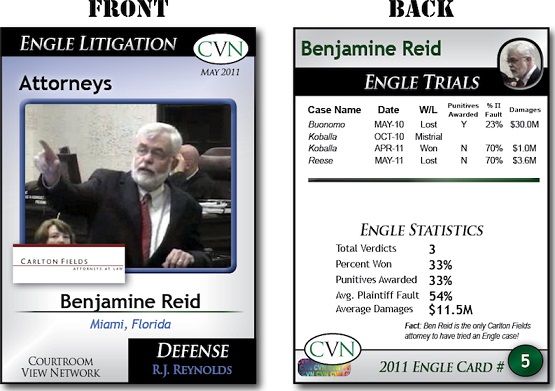
Engle Trading Card Tuesdays: Series 1Flashback, Take Two

Posted by Arlin Crisco on Sep 2, 2014 2:50:13 PM

Last week's flashback to our Series 1 Engle trading cards was so popular, we were asked to feature a few more key cards from that series and highlight how their subjects have fared over the last three years. Our upcoming Series 2 cards feature new attorneys, law firms, and cases, with the most current statistics on this critical Florida tobacco litigation.

Read More

Topics: Engle Litigation Trading Cards, Tobacco Litigation

Five Keys to Minimize Daubert Exclusions of Your Financial Expert Witnesses

Posted by Arlin Crisco on Sep 2, 2014 9:38:03 AM

This graph, from PwC's 2013 edition of Daubert Challenges to Financial Experts: A Yearly Study of Trends and Outcomes, shows the exclusion rate of financial expert testimony by type, comparing 2013 to 14-year averages. Graph used by permission of PwC.

Financial expert witness testimony can be a critical component to your case, particularly in damage calculations. However, history shows that you face a significant risk of your expert’s testimony being excluded in federal court. In 14 years of courts' application of Daubert criteria to financial experts, 46% of the more than 1,500 challenges to financial experts in federal courts have been successful.

Fortunately, history also shows that you can minimize the chances your financial expert’s testimony will be excluded. Doug Branch and Saleema Damji, part of the team that develops the PricewaterhouseCoopers annual study detailing challenges to financial experts, say many exclusions are potentially preventable. The PwC study, Daubert Challenges to Financial Experts: A Yearly Study of Trends and Outcomes, has evaluated more than 1,500 published court opinions since 2000. The study and its statistics shed light on why expert witnesses are excluded and how to increase your chance of success against a Daubert challenge.

Here are five points to consider when using a financial expert witness:

1. Hire your experts early and allow them the proper time to prepare. Branch and Damji said attorneys may be tempted to hire experts as close to trial as possible, hoping to save money. However, rushed research and exclusions due to missed deadlines can have the opposite effect.

2. Ensure your witness’s methodology and studies are peer-tested and their results are supported by relevant statistics. From 2000-2013, reliability is the most common reason for excluding a financial expert witness. Reliability exclusions typically occur because of a lack of valid data, according to the PwC study's 2010 edition.

3. On the other hand, don’t push your financial witness into a conclusion outside the scope of their expertise. Relevance exclusions, which typically occur with testimony outside the expert’s role, have historically been the second-leading cause of exclusions. Branch attributes the high rate of these exclusions in part to overly aggressive attorneys that push financial expert witnesses outside their “comfort zone.”

4. Be especially vigilant and take extra time to prepare for a challenge if you’re trying a fraud or intellectual property case. In 2013, more than half of the challenges in each of these types of cases were successful. Moreover, Branch predicts that the rate of challenges in intellectual property cases will remain high because of the subjectivity in damage models.

5. Pay particular attention to appraisers’ testimony. Although accountants and economists tend to be more frequently challenged than appraisers, the exclusion rate for appraisers is higher. In 2013, appraisers’ testimony had a 45% exclusion rate, a dip from its historical average of 47%, but still high enough to take notice. By contrast, accountants faced a 29% exclusion rate in 2013, a significant drop from the study's historical average of 43%.

You can’t necessarily prevent a Daubert challenge to your expert witness. However, if you give your experts proper support and time to prepare without being too aggressive on the conclusions you want them to reach, you can minimize your chances of exclusion and deliver the strongest evidence to support your case.

Related Information

Read the 2013 edition of Daubert Challenges to Financial Experts: A Yearly Study of Trends and Outcomes.


Read More

Topics: Trial Techniques, Litigation Strategy

Engle Progeny Review for the Week of August 25

Posted by Arlin Crisco on Aug 29, 2014 3:14:21 PM

Each Friday, we’ll highlight the week’s Engle progeny proceedings and look ahead to next week.

Robert A. Wilcox v. R.J. Reynolds, et al.

Read More

Topics: Negligence, Engle Progeny, Tobacco Litigation

Boston Scientific Wins Second Key Massachusetts Pelvic Mesh Lawsuit

Posted by Arlin Crisco on Aug 29, 2014 9:34:22 AM

Judge Diane Kottmyer addresses jurors following their verdict in favor of Boston Scientific and its Obtryx pelvic mesh device. The decision is the second key Massachusetts verdict in favor of the company and its pelvic mesh products. Click here to view the verdict.

Boston Scientific prevailed on a jury verdict today in a key Massaschusetts pelvic mesh suit against the company. Maria Cardenas v. Boston Scientific.

After two-and-a-half days of deliberations, jurors found Boston Scientific's Obtryx pelvic mesh device was not defectively designed and that the company adequately warned Maria Cardenas's treating physician of the possibility of erosion inside the body. Cardenas, who had the Obtryx pelvic mesh device implanted in 2008, sued Boston Scientific company after the device eroded inside her and had to be removed.

The verdict may signal a trend in Massachusetts suits against Boston Scientific and its pelvic mesh products. In July, the company prevailed in the the state's first suit against it and its Pinnacle pelvic mesh device. The company faces hundreds of potential lawsuits in Massachusetts alone over its pelvic mesh devices. Nationwide, there are more than 100,000 claims against Boston Scientific and other pelvic mesh manufacturers.

The week-long Cardenas trial turned on testimony surrounding the product’s design and conflicting opinions on its safety and risks. Cardenas's attorneys argued that Boston Scientific’s own internal documents pushed sales of the pelvic mesh device despite questions concerning its safety, and that the company failed to warn of device shrinkage of 20% or more inside the body. Her counsel also claimed that Boston Scientific's expert witness testimony conflicted with their own previously published articles questioning the mesh. "Maybe their experts are not shooting straight with you guys," Cardenas's attorney Doug Monsour told jurors in closing statements. "They're telling you Boston Scientific's story."

By contrast, Boston Scientific’s counsel offered testimony from experts that its mesh had a strong history of safe use, and that its directions for use clearly warned of the possibility of erosion. In closing arguments, Boston Scientific's attorney Susan Murphy reminded jurors of of more than 20 clinical studies on the pelvic mesh's safe design and expert testimony endorsing its use. "The community (of urologists) does not believe this product to be unreasonably dangerous. To the contrary, they believe it to be safe and effective," she said.

Outside Massachusetts, other manufacturers have fared worse in pelvic mesh litigation. In July, a New Jersey Superior Court upheld an $11.1 million verdict in Linda Gross v. Ethicon, one of the state’s bellwether pelvic mesh cases. That trial, recorded by CVN, led to a jury finding that Ethicon, a subsidiary of Johnson & Johnson, misrepresented its product and failed to warn Gross’s physician of its risks. Earlier this year, a Texas jury awarded Linda Batiste $1.2 million in her pelvic mesh suit against Ethicon. In August, manufacturer C.R. Bard agreed to settle more than 500 pelvic mesh suits pending in Texas.


Related Information

View the verdict.

View on-demand video of the case.

Read Plaintiff Testifies in Massachusetts's Second Pelvic Mesh Trial Against Boston Scientific.

Read Boston Scientific Wins First Jury Decision in Massachusetts Pelvic Mesh Suit.

Read More

Topics: Products Liability, Pelvic Mesh Litigation

Jury Awards $3.1 Million in Compensatory Damages in Florida Tobacco Lawsuit, Irimi v. R.J. Reynolds

Posted by Arlin Crisco on Aug 28, 2014 3:23:37 PM


Miami, FL—Jurors awarded the daughter of a deceased smoker more than $3 million for her father’s smoking-related pain, suffering, and medical expenses, but refused to find tobacco companies liable for punitive damages in her Engle progeny suit. Heather Irimi v. R.J. Reynolds Tobacco Co.

Read More

Topics: Engle Progeny, Tobacco Litigation