
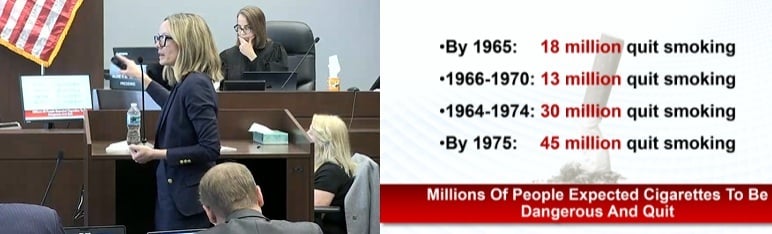
King & Spalding's Kathryn Lehman delivers her closing argument on behalf of R.J. Reynolds at trial over the lung cancer death of a long-time smoker. Watch the trial.
Miami, FL— A Florida jury cleared R.J. Reynolds of the lung cancer death of an Emmy Award-winning CBS cameraman who had smoked the company’s cigarettes for decades. Sacs v. R.J. Reynolds, 2015-CA-025339.
The 11th Circuit Florida State Court jury deliberated less than four hours before finding in favor of Reynolds on defective design, fraud, and conspiracy claims related to the 2006 death of Stanley Gould.
Born in 1922, Gould smoked for more than a half-century, favoring R.J. Reynolds-brand cigarettes for much of that time. A long-time CBS cameraman before retiring to Florida in 1983, Gould died of lung cancer in 2006. His family claims that Reynolds is responsible for his fatal cancer by marketing defectively designed cigarettes and working for decades to conceal the dangers of smoking.
The case is a relatively rare Florida tobacco claim that does not fall within the so-called “Engle progeny” litigation against the nation’s cigarette companies. While individual Engle-progeny cases stem from a decertified class action in which some defective design issues are already found against defendants, the issue of whether Reynolds cigarettes were defectively designed, and its link to Gould’s cancer, played a central issue over the two weeks of this trial.
During closings late last month, Carlos Salazar, of Richard J. Diaz, P.A., representing Gould's family, walked jurors through evidence that he said showed Reynolds engineered cigarettes to be as addictive as possible, including by manipulating levels of nicotine and making them more easily inhalable, all while knowing the links between cigarettes and cancer.
“Just because cigarettes are dangerous doesn’t mean they’re defective,” Salazar said. “They’re defective in terms of what R.J. Reynolds did to make them more dangerous.”
But Reynolds contends that cigarettes are inherently dangerous. And in her closing argument, King & Spalding’s Kathryn Lehman told jurors added that Gould knew for decades that smoking was dangerous, but failed to quit in time to avoid his cancer.
“He was resolute,” Lehman said about Gould's smoking, while noting testimony that Gould was unwilling to quit for decades, despite numerous health warnings. “That was the decision that he made throughout his life.”
Email Arlin Crisco at acrisco@cvn.com.
Related information
Not a subscriber?