

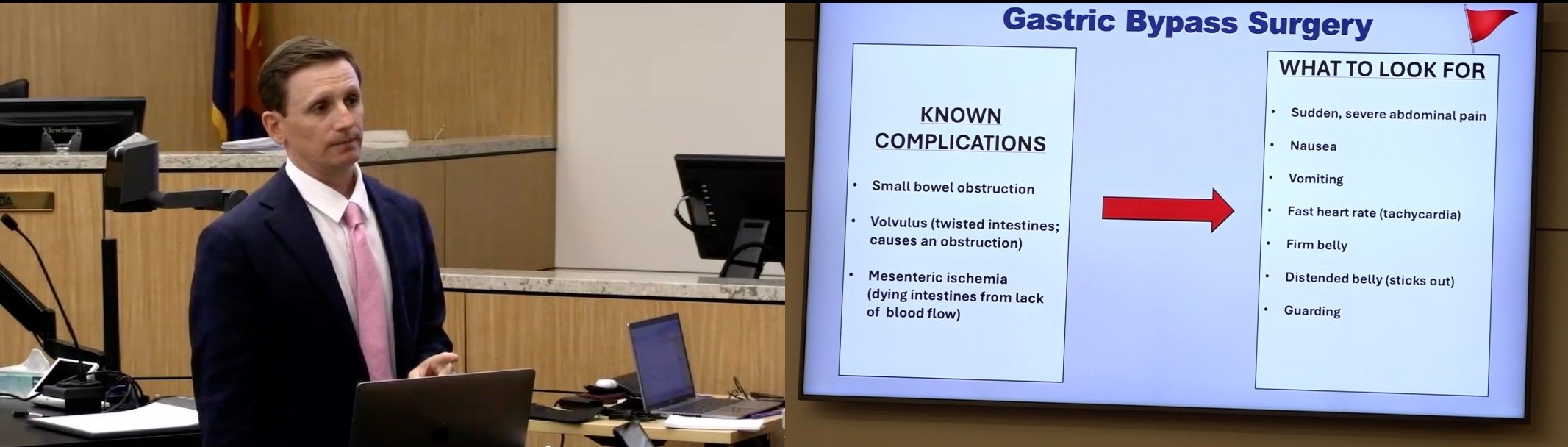
CVN screenshot of plaintiff attorney Brian Snyder delivering his opening statement
Phoenix, AZ - An Arizona state court jury heard opening statements Tuesday in a medical malpractice lawsuit claiming a gastroenterologist’s alleged failure to properly diagnose an obstructed bowel caused a 41-year-old man’s death, and the full trial is being webcast gavel-to-gavel by Courtroom View Network.
Attorney Brian Snyder of Snyder & Wenner, representing the family of decedent Johnny Ballard, told a Maricopa County jury that Ballard’s death in 2019 was entirely preventable if Dr. Krishdeep Chadha had ordered a CT scan with contrast dye after Ballard arrived in a Banner Health emergency room with excruciating stomach pain.
Snyder accused Chadha of ignoring classic signs of a bowel obstruction while hospital staff kept increasing Ballard’s opiate dosage to mask the pain, but Chadha’s attorney argued the CT scan without contrast dye met the standard of care to rule out an obstruction, and that Ballard suffered from a rare condition that is difficult to diagnose and complicated further by his history of gastric bypass weight loss surgery.
Subscribers to CVN’s trial video library get unlimited live and on-demand access to the full trial, along with hundreds of other trials featuring many of the top plaintiff and defense attorneys in the United States. Not a subscriber? Sign up today for a monthly or annual account and start watching the trial pros in this case and many others.

Snyder told jurors that Ballard received 16 does of fentanyl, the most powerful pain medication available in a hospital, after being admitted. He’d recently been sent home after an earlier ER visit for stomach pain, when he received a CT scan without contrast dye to check for kidney stones.
After a few days being treated continuosly with pain medicine Ballard eventually vomited a massive amount of blood and died after going into cardiac arrest, with his autopsy report confirming an obstructed bowel as the cause of death.
Snyder accused Chadha of improperly relying on the initial CT scan to rule out an obstructed bowel when Ballard returned to the hospital. Snyder characterized a bowel obstruction as a “can’t miss” diagnosis that is fatal if not surgically treated and insisted it should be one of the first things to rule out when treating gastric bypass patients. He stressed a CT scan with contrast dye would immediately reveal an obstruction.
“He never even consider an obstruction,” Snyder told the jury. “It is nowhere in his differential diagnosis.”
Chadha diagnosed Ballard with hemorrhagic gastritis, an inflammation of the stomach lining, but Snyder said the experts who testify would say that doesn’t line up with Ballard’s distended abdomen, unusually intense pain and rapid heart rate.
“Every gastroenterologist in this case agrees these are the classic signs of a small bowel instruction,” he said.
Snyder did not specify the amount of damages he would seek at the end of trial, but he told jurors they would be significant.
Representing Chadha, defense attorney Katherine Corcoran of Broening Oberg Woods & Wilson argued the specific type of bowel obstruction Ballard had, known as a volvulus, is a “very rare complication that presented in a very unusual manner.”
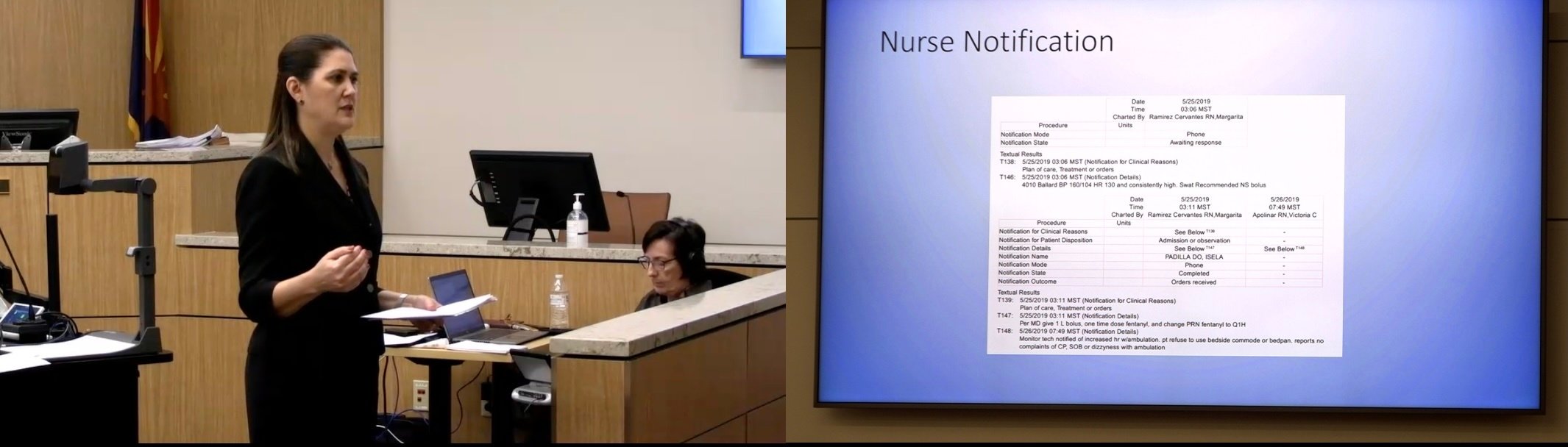
CVN screenshot of defense attorney Katherine Corcoran delivering her opening statement
She urged jurors not to rely on Ballard’s pain levels, which she described as a “subjective” measure of his condition as contrasted with the “objective” indicator of his vital signs, which she said largely remained stable during his time at the hospital.
Corcoran told jurors that nurses informed Chadha Ballard’s pain responded to the medication, and that none of the reports he received from bedside nursing staff indicated Ballard was in immediate danger.
Addressing an issue that will be a likely point of intense contention among the experts in the trial, Corcoran insisted that a CT scan without contrast dye can reveal bowel obstructions, and that Chadha was reasonably unconcerned about an obstruction given a recent negative CT scan.
The trial is scheduled to run through April 3, and CVN's gavel-to-gavel coverage will continue for the dureation of the proceedings.
The case is captioned Heather Ballard, et al. v. Krishdeep Chadha MD, case number CV2020-014913 in Maricopa County Superior Court.
Email David Siegel at dsiegel@cvn.com