

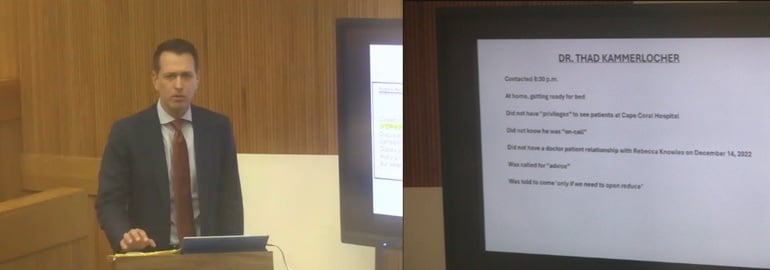
Ryan Fogg delivers his closing argument in a medical negligence trial over the arterial blockage that cost a woman part of her leg. Watch the trial.
Ft. Myers, FL—A Florida state court jury last week awarded more than $7.6 million to a woman after finding two medical professionals’ negligence cost her part of her leg. Knowles v. Ensley, D.O., et al., 2024CA006215.
The jury, in Florida’s 20th Circuit, deliberated roughly four hours before finding Dr. Tyler Ensley and physician assistant Alexandria Erickson responsible for the below-the-knee amputation Rebecca Knowles was forced to undergo in 2022 due to complications stemming from a dislocated left knee.
Knowles, then 55, was treated by Ensley and Erickson at Cape Coral (Florida) Hospital’s emergency room following a fall in her home that caused the dislocation. The injury blocked an artery, and Knowles contends Ensley and Erickson failed to diagnose or treat the blockage in time to avoid the amputation.
In commenting on the award after the verdict, Knowles’ attorney, Ryan Fogg, of the Fogg Law Group, told CVN that the defense had not made any offers to settle the case either prior to or during trial.

Knowles was treated by Ensley and Erickson in the Cape Coral ER for roughly four-and-a-half hours before she was admitted to the hospital. She ultimately did not undergo a vascular repair procedure until she was transferred to another facility the following evening. But it is the defendants’ treatment of Knowles during her hours in the ER that served as the central focus of the three-day trial.
During Friday’s closings, Erickson and Ensley’s attorney, Louis La Cava, of La Cava Jacobson, told jurors that evidence showed the two healthcare providers followed appropriate protocol in diagnosing and treating Knowles during her time in the ER.
La Cava noted that X-rays taken shortly after Knowles arrived in the emergency room led Erickson to order computed tomography angiography, or CTA, imaging, meant to determine whether Knowles had suffered an arterial blockage. Meanwhile, Ensley tried unsuccessfully to reduce, or realign, the dislocated knee. La Cava added that the CTA results showing the arterial blockage were reported to Erickson as Knowles was leaving her care, and the physician assistant relayed those results to the orthopedic surgeon brought in to operate.
“Nobody, nobody who’s being honest, who’s under oath, who’s in the same specialty, would say that’s below the standard of care,” La Cava said.
But Fogg argued that Erickson and Ensley should have done more to secure a specialist to attempt to revascularize the leg, especially given physical signs of the blockage. In his closing Friday, Fogg reminded jurors of a photo Knowles’ friend took of Knowles’ leg while she was in the ER. That photo showed the leg was discolored, a warning sign of a blockage. Yet, Fogg said, Erickson never reported that discoloration. And Fogg added that, while Erickson reported the imaging results showing the arterial blockage to an orthopedic surgeon, she never contacted a vascular surgeon with those results.
Fogg said the lost time in the ER without working to repair the blockage was what ultimately cost Knowles her leg.
“Rebecca Knowles sat in that emergency room for almost five hours without a vascular surgery expert,” Fogg said before requesting roughly $12 million in damages. “Just ordering a CTA, that’s not enough. You have to act. You have to do something!”
After the verdict, Fogg told CVN he believed the photo showing Knowles’ leg discoloration in the ER was one of the most compelling pieces of evidence for the jury. “[The discoloration] is not mentioned at all in the medical records, there’s no action taken on it,” Fogg said. “And it was something [jurors] could very visibly see with their own eyes.”
The three-day trial was relatively quick for a medical malpractice case with negligence, causation, and damages at issue. Fogg noted that the case had been allowed two trial weeks, but said he aimed to be as efficient as possible with the evidence to respect jurors’ time. “I always feel that the quicker that you can get the issues in front of the jury and let them digest it and make their decision, the better you are,” Fogg said. “We were able to get all of the evidence in within that [one] week, and I think it paid off.”
CVN has reached out to Louis La Cava and will update this article with his comments.
Email Arlin Crisco at acrisco@cvn.com.
Related information
Not a subscriber?
Learn how you can watch an unrivaled trial video library.