

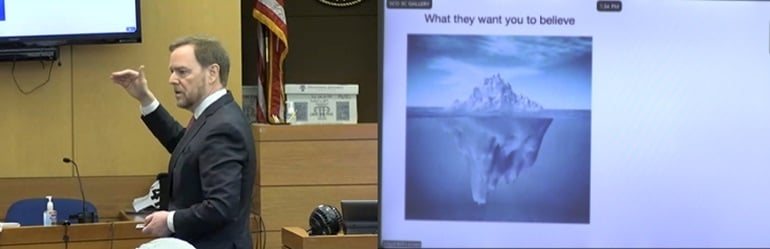
Lloyd Bell delivers his closing argument in the liability phase of a medical malpractice trial against a dermatologist for the skin cancer that disfigured a Georgia man. Jurors ultimately found the physician liable and handed down a $48 million verdict. Watch the trial.
Atlanta, GA— Jurors Wednesday awarded $48 million for the skin cancer that disfigured a Georgia man, after they found a dermatologist who treated him responsible. Waldrop v. Payne, et al. 17EV004844.
The award includes $32 million for Tony Waldrop’s pain and suffering and $16 million to his wife for the skin cancer, discovered in 2014, that cost Waldrop most of one ear, his teeth, and salivary glands, and left him with a host of complications. Wednesday’s award comes one day after the same Fulton County (Georgia) State Court jury found Dr. Joseph Payne, a dermatologist who treated Waldrop, responsible for the skin cancer injuries.
The $48 million verdict far exceeds the highest pre-trial settlement offer of $2 million, Patricia Waldrop’s attorney, Bell Law Firm’s Lloyd Bell, wrote in a statement to CVN after the verdict, though he added that the combined insurance policy limits were $4 million.
Waldrop’s February 2014 skin cancer diagnosis and surgery, which was not performed by Payne, came eight months after Payne had conducted a “Mohs" procedure to remove skin cancer from near Waldrop’s ear, and roughly two months after Payne had removed what he diagnosed as a cyst in the same region that the 2014 cancer was ultimately discovered. Waldrop died in 2022 for reasons unrelated to the 2014 skin cancer. Patricia Waldrop contends Payne failed to properly treat Waldrop in those months leading up to the 2014 diagnosis, causing his ultimate disfigurement.

Waldrop, who was a Vietnam veteran exposed to carcinogenic Agent Orange during his service, had a history of various cancer occurrences, including skin cancer, and was treated multiple times by Payne and others in 2013. Payne's treatment that year, particularly whether he reasonably should have done anything more that could have discovered the 2014 cancer earlier and avoided the disfiguring surgery, served as the key battleline in the case.
During Tuesday’s closings in the bifurcated trial’s liability phase, Payne’s attorney, Huff Powell Bailey’s Taylor Tribble, walked jurors through Payne’s treatment of Waldrop. She said evidence showed Payne followed the standard of care in conducting the June 2013 Mohs procedure, and she reminded jurors the dermatologist followed up repeatedly with Waldrop multiple times in the months afterward. Tribble added that Waldrop saw other physicians in the latter half of 2013, and none of them suspected a cancer recurrence.
Tribble told jurors the disfiguring cancer was a tumor so deep that Payne could not have reasonably discovered it, and she said tissue slides taken during the June Mohs procedure showed nothing that would have raised suspicion.
Turning to Payne's December 2013 removal of another growth from near Waldrop's ear, Tribble said the doctor followed the standard of care in not ordering a biopsy, given his conclusion that the growth was a cyst.
“Recurrent cancer sometimes happens even if you comply with the standard of care,” Tribble said. “Cancer can recur, even if you do every type of treatment possible.”
But in his closing, Bell argued Payne breached the standard of care at multiple points throughout his treatment of Waldrop. He said Payne declared Waldrop cancer-free after the June Mohs 2013 surgery, despite tissue slides that were inconclusive on the issue. And he argued evidence showed Payne should have referred Waldrop for possible radiation treatment following that procedure, which Bell said would have eradicated any deeper cancer tissue that remained.
Bell then noted that Payne did not order a biopsy of the tissue he diagnosed as a cyst in December 2013. Bell argued evidence showed a biopsy would have revealed the cancer in time to avoid many of the most serious effects of Waldrop’s February 2014 surgery.
“You practice medicine to the standard of care to save patients; not be negligent and allow a horrible outcome and then throw your hands up and just say ‘Well bad outcomes can just happen,’” Bell said. “That’s not responsible medicine. Tony deserved better.”
This week’s set of verdicts on liability and damages wrapped the latest chapter in a case that has stretched across multiple trials. A 2020 proceeding ended in mistrial shortly after openings. And, while a January 2024 retrial in the case led to a defense verdict, a motion for new trial was subsequently granted based on evidentiary issues in the proceeding.
In a statement to CVN after Wednesday’s verdict, Bell wrote that he believed a report on the June 2013 Mohs procedure at issue was a key piece of evidence in the jury finding the dermatologist liable. Bell said the report omitted a description of the extent of nerve involvement that could greatly increase the risk for recurrence and was relevant in whether Waldrop should have been referred for possible radiation treatment.
“Dr. Payne explained that a nurse ‘forgot to check a box’ to populate this part of the record. When I pointed out that he later signed the note, he suggested it was just his oversight,” Bell wrote. “To further erode his credibility, Dr. Payne had performed three other Mohs surgeries on Tony, including an additional one on the day of the subject Mohs, and all of them had complete operative reports. The only one missing was the Mohs procedure at issue.”
And in a statement to CVN after the verdict, Payne’s attorney, Huff Powell Bailey’s Page Powell, noted the difference between the result in this trial and the proceeding before it.
“We are disappointed and surprised at this latest nuclear verdict. It’s especially puzzling since we tried this same case two years ago and we won the case decisively, receiving a quick defense verdict. Very little changed from the last trial to this one—except the jury,” Powell wrote. "For two separate juries to hear essentially the same evidence and return such disparate verdicts is just more evidence of how unpredictable and volatile our current civil jury system is.”
Powell added that the defense team is considering their options moving forward in the case. “We believe there are multiple appellate issues to consider and we currently are analyzing them carefully.”
Email Arlin Crisco at acrisco@cvn.com.
Related information
Not a subscriber?
Learn how you can access an unrivaled trial video library.