

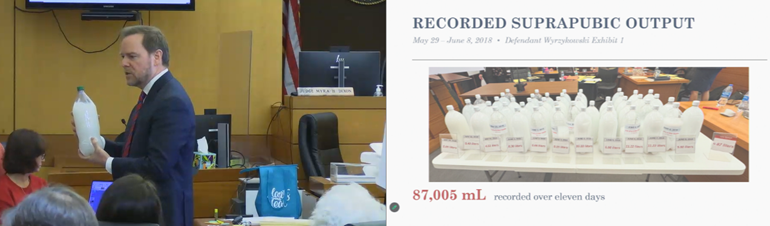
Lloyd Bell delivers his closing argument at trial over the death of a 76-year-old man following a lymphatic fluid leak. A Georgia jury found two physicians that treated him negligent, handing down a $15 million award, and cleared two other physicians who cared for him. Watch now.
Atlanta, GA— Jurors last week handed down a $15 million verdict at trial over the death of a 76-year-old Georgia man, after finding two physicians were negligent in treating him. Oh v. Jeffries, M.D., et al., 20EV002508.
The Fulton County (Georgia) State Court jury issued the award for the 2018 death of Byung “Ben” Oh, who succumbed to organ failure following the leakage of chyle, a type of lymphatic fluid, across multiple days. Jurors apportioned 67.5 percent of responsibility to Dr. Amy Wyrzykowski, Oh’s attending physician at Wellstar Atlanta Medical Center, and 32.5 percent of fault to Dr. Barry Jeffries, a radiologist who performed a suprapubic, or abdominal, catheterization procedure on Oh.
Jurors cleared two other physicians who treated Oh, Dr. Khalid Iqbal, a nephrologist, and Dr. Thomas Schoborg, a urologist.
In an email to CVN after the verdict, Jeffries' attorney, Huff Powell Bailey’s Dan Huff, said the award against his client fell within the range of a negotiated high-low settlement agreement.
Oh was admitted to Wellstar Atlanta Medical Center following a fall that broke his back. During post-op recovery over the next several weeks, Oh began showing signs of abdominal distension and decreased urine output. Following the abdominal catheterization procedure, roughly 87 liters of milky, whitish fluid, ultimately found to include chyle, drained from Oh over the next 11 days. He ultimately died of septic shock and organ failure.

Oh’s daughter and her attorney, the Bell Law Firm's Lloyd Bell, claim that attending physician Wyrzkowski failed to properly coordinate care among the treatment team. They also contend Jeffries mispositioned the catheter during the procedure and that the defendant physicians failed to properly follow up on the fluid leakage before and after the catheterization.
The 10-day trial, bifurcated under Georgia law into liability and damages phases, turned largely on the care surrounding the fluid leak and its symptoms.
During closings in the case’s liability phase, Wyrzykowski’s attorney, The Weathington Firm’s Paul Weathington, noted Oh suffered from a range of health conditions beyond the fluid leak, including pneumonia and kidney failure. Weathington added that the chyle leak Oh suffered was extraordinarily rare, and that Wyrzykowski acted within the standard of care in investigating the fluid output, while reasonably expecting the catheter was properly placed.
“They are doing their best to try to figure this out, being told that urine is coming out, not thinking that a catheter is in the peritoneal cavity,” Weathington said. “It’s a hindsight case and you can’t base a verdict on hindsight.”
Huff, representing radiologist Jeffries, agreed with Weathington’s hindsight contention, arguing that, while the catheter was ultimately found to be misplaced, Jeffries was not negligent in attempting to place it. Huff noted that Jeffries relied on video imaging during the procedure and that immediate drainage led him to believe the catheter was appropriately placed.
“The question is not whether the catheter was misplaced. We know it was,” Huff said. “The question is really: were reasonable steps taken in its placement? And they were.”
But Bell, representing Oh's daughter, said medical errors began even before the catheterization. He argued evidence showed Wyzykowski failed to properly follow up on a finding of abnormal fluid in Oh’s abdomen well before the procedure. And urologist Schoborg, Bell said, then improperly concluded without accurate medical evidence, that Oh’s limited urine output was caused by a kidney obstruction.
Once the catheterization was performed, Bell said, the “grossly abnormal” color of a half-liter of fluid that drained immediately after the procedure should have warranted more follow-up from Jeffries and Wyrzykowski to determine whether the catheter was properly placed.
Bell told jurors that Jeffries, Wyrzykowski, and nephrologist Iqbal compounded that error by failing to follow up on any question of catheter placement or what was in the 87 liters of fluid that drained from Oh over the next 11 days.
“All of this is being drained out of his body under the very eyes of his so-called care team, and nobody does anything about it.” Bell said. “It drained out of his body day after day after day, and all of these defendants say ‘Not my job.’”
But Schoborg’s attorney, Copeland Stair Valz & Lovell’s Rolfe Martin, pushed back on that argument in his closing. Martin noted Schoberg’s limited role on the team, and said there was nothing to indicate the inaccuracy of bladder scans on which Schoborg relied in diagnosing a urinary obstruction and ordering catheterization. Martin added that Schoborg, as a urologist, was not the fluid-management expert on the care team and not expected to take the lead in determining what was causing the abnormal output.
“There is a good reason for having a high-volume [of fluid output]. But it’s not something a urologist is going to determine,” Martin said. “Nobody’s looking to Dr. Schoborg to make that decision.”
Iqbal’s attorney, McGrew Miller Bomar & Bagley’s Spencer Bomar, also noted his client’s limited role in Oh’s care. Bomar reminded jurors that Iqbal was called in specifically for Oh’s diagnosed kidney disease. And Bomar contended the doctor atced appropriately in issuing orders and following up as part of that team. Bomar added that evidence established the chyle leak was diagnosed within a reasonable time, given the circumstances and the web of health conditions affecting Oh.
“Yes, it was a 'mess,'” Bomar told jurors, using the word a defense expert used in describing Oh’s overall condition. “But it’s a mess that these care providers courageously faced and tried to help.”
In an email after the verdict, Bell told CVN he believed the case centered on inaccurate assumptions surrounding Oh’s fluid output.
“The case really came down to a simple but powerful point—the care team repeatedly overlooked obvious evidence that, over an 11-day period, the catheter was draining lymphatic fluid rather than urine,” Bell said. “They all assumed the white, milky fluid was urine and didn’t check to make sure the catheter was in the bladder. They assumed instead of investigating, which was the theme of our case.”
Huff, in his emailed statement, praised the jury, while the case’s difficult circumstances. “It was a well-tried case to a very attentive jury. We had the difficult job of defending a misplaced catheter and know from talking to the jurors that they struggled over finding fault for our clients,” Huff said.
Martin also praised the jury in a statement to CVN after the verdict. “We had an amazing jury and a delightful judge. The case was exceptionally well tried by all involved, as I was surrounded by some of the best lawyers in Atlanta,” Martin said. “My client is gratified the system worked and relieved the case is finally over after the verdict in his favor.”
Martin, who was hospitalized the weekend before he delivered Monday’s closings on liability, told CVN he left the hospital to ensure the proceeding wouldn’t be delayed or end in a mistrial.
“I am doing fine, but the win was especially gratifying under the circumstances.”
Email Arlin Crisco at acrisco@cvn.com.