

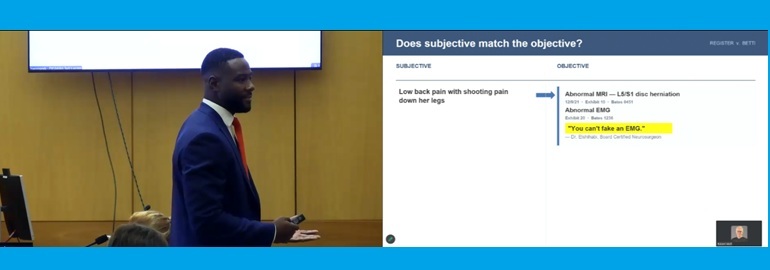
Joseph Wilson, of Trial Lawyers for Justice, delivers closing arguments at trial over the injuries a Georgia woman suffered in a vehicular collision. Jurors awarded $1.59 million in the case. Watch the trial.
Atlanta, GA — Jurors last Thursday handed down a $1.59 million verdict at trial over the life-long injuries a Georgia woman says she suffered in a 2021 car crash. Register v. Betti, 23EV000338.
The Fulton County (Georgia) State Court jury closed a full day of deliberations by issuing the award for the traumatic brain, neck, and back injuries Chelsea Register contends she suffered when her car was struck by a vehicle driven by defendant Alessandro Betti.
Last week’s award was more than three times the defense’s top pre-trial settlement offer of $500,000, Register’s attorney, Nicholas Rowley, of Trial Lawyers for Justice, told CVN after the verdict.
Betti admitted liability for the crash, leaving the four-day trial to focus on whether the collision caused Register’s injuries and what damages were sufficient.
And in Wednesday’s closings, attorneys focused on the medical evidence surrounding Register’s injuries.
Betti’s attorney, Downey & Cleveland’s Christopher Harrison, reviewed evidence he argued undercut the severity of the injuries Register claimed. Harrison noted ER medical records from a day after the crash concluded Register suffered from no head trauma. Instead, Harrison said, Register’s first visit specifically for treatment of concussion, or mild TBI, symptoms came months after the crash, while medical records showed Register significantly recovered from her symptoms in the months during her treatment.

And Harrison pointed to a 2023 exam that found Register’s cognitive abilities “largely intact,” while evidence indicated that pre-existing anxiety and depression could have been the cause of any cognitive issues from which she suffered.
“You look at the ER, you look at her lack of treatment after that, you look at what happened with (her 2021 treatment for concussion symptoms) and the recovery? All that’s moving in the right direction,” Harrison said, before suggesting jurors award $204,000 in medical expenses and no more than $200,000 for pain and suffering. “Nobody has explained why it allegedly went the other way.”
However, Register’s attorney, Joseph Wilson, of Trial Lawyers for Justice, told jurors that Register’s anxiety was controlled before the crash. Meanwhile, he said, the collision left her with a slate of injuries that caused her chronic back pain, severe anxiety and depression, migraines, memory loss, and other cognitive issues stemming from the traumatic brain injury. Wilson added that the weight of medical testimony concluded that the fallout from Register’s injuries, including the traumatic brain injury, would last the rest of her life.
Wilson said that these injuries affected every aspect of her life, from limiting her work options and daily activities to living with the uncertainty of future symptoms, including increased odds of dementia as she grew older.
“She does not know what her future holds, for her back or for her brain,” Wilson said, before suggesting jurors award between $30 million and $50 million. “She doesn’t know how bad this is going to get for her. She’s got to live with that every single day.”
After the verdict, Rowley said jurors told him that the fact that Register started a new job days after the collision, combined with her reporting that her neck and back pain had resolved and her headaches significantly decreased within months of the collision, made it difficult for them to believe her injuries were permanent.
Rowley said the unusual timeline of symptoms can be a significant hurdle in mild traumatic brain injury, or mTBI, cases. “The toughest thing about mTBI cases is that they are not worked up right early on. The reason is that there is little to nothing that can be done in the first six months apart from resting the brain and waiting to see if there is a full recovery. Most mTBI victims go back to living their lives and recover,” Rowley said. “The 10-30% who do not recover most often take many months and even years to appreciate the long-term problems that they have from the brain injury.”
Rowley added that the case had been through multiple lawyers before reaching his firm. “I was asked to try the case last week. I agreed and flew to Atlanta on Saturday, reviewing the file on the flight,” Rowley said. “We did the best we could with what we had.”
CVN has reached out to Downey & Cleveland’s Christopher Harrison and will update this article with any comments.
Email Arlin Crisco at acrisco@cvn.com.