

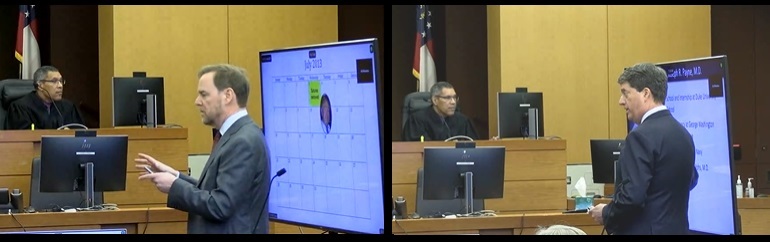
Bell Law Firm's Lloyd Bell and Huff Powell Bailey's R. Page Powell, Jr. deliver openings in a medical malpractice trial against a dermatologist who treated a man ultimately diagnosed with disfiguring skin cancer. Watch the trial.
Atlanta, GA— Attorneys Tuesday previewed evidence surrounding the skin cancer that seriously disfigured a Georgia man, as trial opened against a dermatologist who treated him. Waldrop v. Payne, et al., 17EV004844.
Tony Waldrop underwent surgery in February 2014 to remove an aggressive skin cancer, a procedure that cost Waldrop most of one ear, his teeth, and his salivary glands. Waldrop died in 2022 for reasons unrelated to that instance of skin cancer. His wife, Patricia Waldrop, contends that Dr. Joseph Payne, a dermatologist with Dermatology Associates of Atlanta, is responsible for the impact of that February 2014 cancer because he failed to properly treat Waldrop in the months leading up to its diagnosis.
Waldrop, a Vietnam veteran exposed to Agent Orange during his service, had a history of suffering from multiple different cancer occurrences before he saw Payne, in June 2013. And that history figures to play an important role in the case.
During Tuesday’s openings, Bell Law Firm’s Lloyd Bell, representing Patricia Waldrop, walked jurors through the timeline of Payne’s treatment of Tony Waldrop. Bells said Waldrop saw Payne to remove a skin cancer in June 2013, adding that Waldrop’s cancer history, along with the location and size of that June cancer, placed him at higher risk of a recurrence of the disease.

Bell said that, despite this increased risk, Payne relied on insufficient evidence from tissue slides in declaring Waldrop cancer-free, after a “Mohs” surgery to remove that tumor. Moreover, Bell said, Payne failed to refer Waldrop to a specialist for possible radiation therapy.
Bell told jurors that, in December 2013, six months after the cancer surgery Payne performed, the doctor diagnosed Waldrop with a cyst near his ear. Bell said Payne then removed that growth but disposed of the tissue, without having it biopsied. Two months later, Bell noted, Waldrop was diagnosed with the ultimately disfiguring cancer in that same area of his head.
Bell said that, especially given Waldrop’s cancer history, evidence would show that Payne breached the standard of care in failing to refer Waldrop for possible radiation therapy after the June 2013 skin cancer surgery, and in failing to order a biopsy of the tissue that Payne had diagnosed as a cyst in December of that year.
“You’ll see a lot of evidence of why it is so important to take a patient seriously when they have these risk factors and they are at risk for recurrent cancer,” Bell said. “Recurrent cancer is freaking horrible. It is a horrible disease. And the only thing worse is not treating it when you have the opportunity.”
But in his opening, Huff Powell Bailey’s R. Page Powell Jr., representing Payne, told jurors the dermatologist followed appropriate medical protocol in treating Waldrop.
Powell told jurors that medical records would show Payne properly evaluated slides of Waldrop’s skin tissue when declaring him cancer-free as part of that June 2013 surgery. Powell added that any questionable issues in the slides’ appearance years later were due to degradation caused by time. And he said that, given Payne’s findings from those slides, there was no need to refer Waldrop for possible radiation treatment.
Powell noted that, in the months following that 2013 surgery, Payne followed up with Waldrop extensively. He also noted that other physicians Waldrop saw during this time did not suspect any recurrence of cancer.
And in December 2013, Powell said, Payne properly relied on his experience and expertise in diagnosing the growth near Waldrop’s ear as a cyst. Given that diagnosis, Powell said, evidence would show the standard of care did not require that tissue to be biopsied.
Powell told jurors that the surgery to remove the 2014 cancer, which he said an expert would describe as deep and aggressive, was unavoidable, despite Payne’s care.
“Recurrent cancer, cancer generally, is sometimes inevitable, despite the best efforts of the medical community to eradicate it,” Powell said. “It’s just true, and we all know it. And it’s especially true in this case, given Mr. Waldrop’s history.”
Trial is expected to last into next week.
Email Arlin Crisco at acrisco@cvn.com.
Related information
Subscribers to CVN’s archive can watch this trial live and on demand.
Not a subscriber?
Learn how you can access an unrivaled trial video library.